Breaking Free from the Boxes: Embracing Neurodiversity and Authenticity

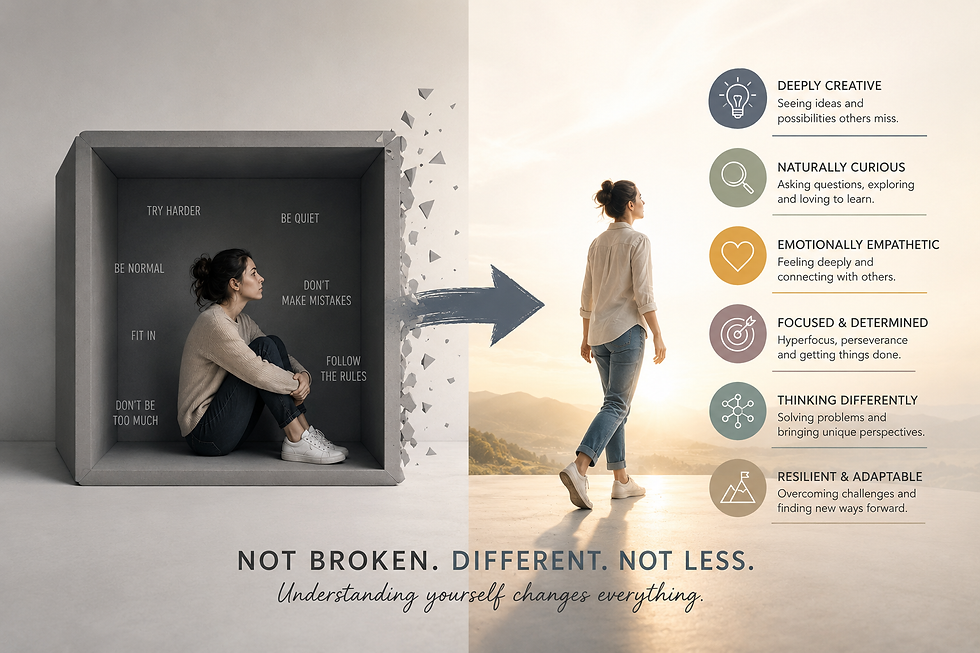
For many people, life feels like a constant effort to fit into predefined boxes. These boxes come in many forms: social expectations, workplace norms, learning styles, and even personality categories. If you have ever felt different—not better or worse, just different—you are not alone. Many spend years trying to squeeze themselves into molds that were never made for them. This struggle often leads to frustration, exhaustion, and a sense of failure.
This post explores why these boxes can be limiting, how understanding neurodiversity can change the way we see ourselves and others, and practical ways to embrace authenticity instead of conformity.
The Problem with Trying to Fit In
From childhood, society teaches us there is a "right" way to behave, think, and succeed. Schools reward certain learning styles, workplaces expect specific communication methods, and social groups follow unspoken rules. These expectations create invisible boxes that many feel pressured to fit into.
Trying to conform can lead to:
Feeling drained or overwhelmed in social or work environments
Believing you are less capable or flawed because you don’t meet certain standards
Constantly pushing yourself to be more organized, disciplined, or consistent without success
For example, someone with ADHD might struggle with traditional time management methods but excel in creative problem-solving. If they only focus on fitting into the "organized and punctual" box, they may miss out on their unique strengths.
Understanding Neurodiversity
Neurodiversity is the recognition that people’s brains work in many different ways. It includes conditions like ADHD, autism, dyslexia, and dyspraxia, but it also applies broadly to all variations in thinking, learning, and processing information.
This perspective shifts the focus from seeing these differences as deficits to appreciating them as natural human variation. Different brains bring different strengths and challenges. For instance:
Autistic individuals may have exceptional attention to detail and deep focus on interests.
People with dyslexia often develop strong problem-solving skills and creativity.
Those with ADHD might thrive in dynamic environments that require quick thinking and adaptability.
Recognizing neurodiversity means understanding that struggling with certain tasks or social norms does not mean failure. It means the framework you are trying to fit into might not be the right one for you.
The Cost of Trying to Fit into the Wrong Box
When people try to force themselves into unsuitable boxes, the consequences can be serious:
Mental health issues like anxiety and depression can increase due to constant self-criticism.
Self-esteem can suffer when efforts to conform don’t lead to success.
Talents and strengths may remain hidden or underdeveloped.
For example, a student with dyslexia might be labeled as lazy or unintelligent if their reading difficulties are misunderstood. This mislabeling can cause lasting harm to their confidence and motivation.
Embracing Authenticity and Neurodiversity
Breaking free from boxes starts with self-awareness and acceptance. Here are some steps to embrace your authentic self:
1. Recognize Your Unique Wiring
Take time to understand how your brain works. This might involve learning about neurodiversity or seeking professional assessments. Knowing your strengths and challenges helps you find strategies that suit you.
2. Challenge Social Norms
Question the "rules" that don’t feel natural. For example, if traditional time management doesn’t work, explore alternatives like visual timers or flexible schedules. If social interactions feel draining, allow yourself time to recharge.
3. Advocate for Yourself
Communicate your needs clearly in school, work, and relationships. This might mean requesting accommodations or explaining your preferred ways of working and communicating.
4. Build Supportive Environments
Surround yourself with people who respect and celebrate differences. Seek communities that value neurodiversity and provide understanding.
5. Focus on Strengths
Identify and develop your talents. Whether it’s creativity, problem-solving, empathy, or innovation, building on strengths leads to greater satisfaction and success.
Practical Examples of Embracing Neurodiversity
A teacher adapts lesson plans to include hands-on activities and visual aids, helping students with different learning styles thrive.
An employer offers flexible work hours and quiet spaces, supporting employees who need different environments to focus.
A friend respects boundaries around social gatherings, understanding that some people need downtime to recharge.
These examples show how small changes can make a big difference in allowing people to be their authentic selves.
Moving From Fixing to Understanding
One of the most powerful shifts I see in neurodivergent adults is when they stop asking:
"What's wrong with me?"
And start asking:
"How do I work?"
That question changes everything.
It moves us away from shame and toward curiosity.
Away from self-criticism and toward self-understanding.
Away from trying to fit into someone else's box and toward discovering what helps us thrive.
The Goal Isn't to Fit In
This might sound strange, but I don't think the goal is always to fit in.
The goal is to understand yourself well enough that you can build a life that works for you.
A life that honours your strengths.
Acknowledges your challenges.
Supports your needs.
Reflects your values.
And allows you to contribute your unique gifts to the world.
Sometimes that means doing things differently.
And that's okay.
The world needs people who think differently.
The innovators.T
he creators.
The deep thinkers.
The pattern spotters.
The problem solvers.
The dreamers.
The people who ask questions others don't think to ask.
Many of the qualities that make life challenging for neurodivergent people can also become some of their greatest strengths when understood and supported well.
A Final Thought
If you've spent years feeling different, exhausted from masking, or frustrated that life seems harder than it should be, perhaps the answer isn't to keep forcing yourself into a box.
Perhaps the invitation is to become curious about how you're wired.
Because understanding yourself isn't making excuses.
It's building self-awareness.
And self-awareness is often where meaningful change begins.
Maybe It's Time to Stop Trying to Fit the Box
What if the goal isn't becoming more like everyone else?
What if the goal is understanding how you're uniquely wired and learning to work with yourself rather than against yourself?
Whether you're newly diagnosed, self-exploring, questioning, or simply exhausted from years of trying to fit in, support is available.
You don't need to change who you are to build a meaningful, healthy, and fulfilling life.
If you're ready to better understand yourself, I'd be honoured to walk alongside you.
Visit www.refinedct.com to learn more or book a session.


Comments